
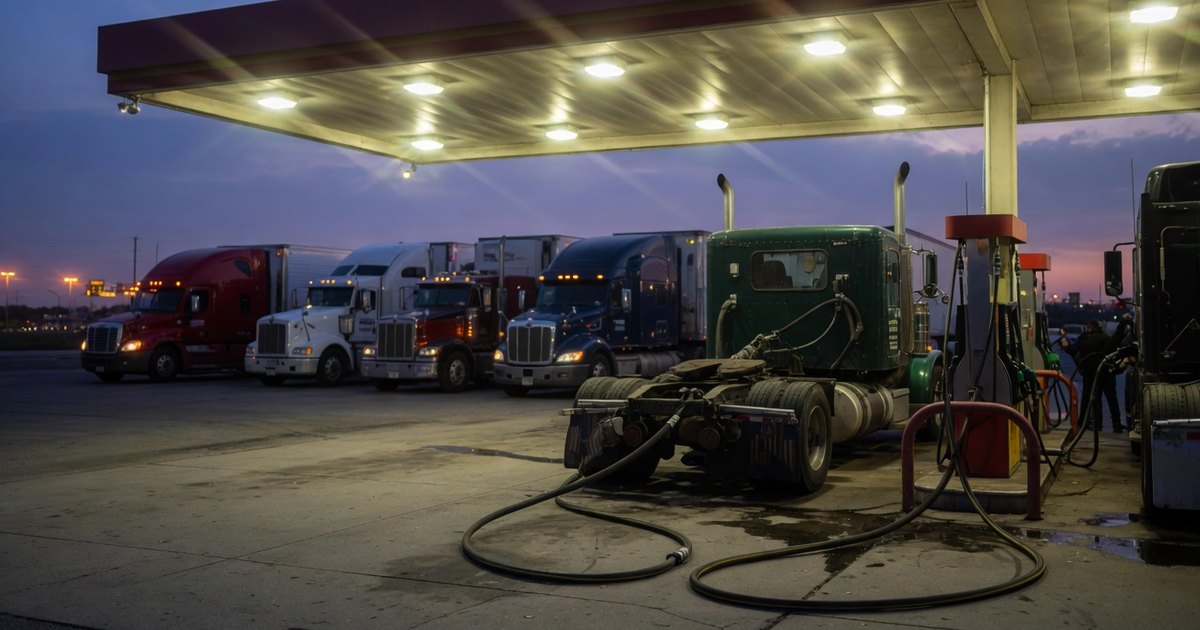
President Donald Trump announced Friday on Truth Social that a phone call with Vladimir Putin produced a commitment from Russia to ship large and escalating volumes of diesel fuel to the American and world markets, and that American prices are headed down as a result. Within hours, the Treasury Department said its Office of Foreign Assets Control was issuing a temporary general license, at the president's direction, to let Russian diesel reach the global market despite existing sanctions.
The announcement lands in a crowded week. Diesel prices are at record levels, the midterm elections are less than a month out, and Ukrainian and European diplomats were arriving in Miami for talks aimed at ending the war. The Hill, in a report Patriot Daily Wire has not independently verified, also tied the move to an Oct. 18 deadline for the president to impose or waive sanctions on Russia's energy industry.
What does not yet exist, at least publicly, is a deal in the ordinary sense of the word. There is a Truth Social post, a Kremlin readout and a sanctions license whose text and expiration date have not been released. No contract, no buyer, no price, no shipper and no delivery mechanism has been identified.
What Trump Actually Said
In the post, Trump wrote that he had "just concluded a highly successful discussion with President Vladimir Putin, of Russia, wherein it was agreed that Russia will immediately supply over 300,000 Tons of Diesel Fuel to the American and Global Marketplace." He said 500,000 tons would follow during November and 1,000,000 tons "immediately thereafter," with up to 3,000,000 additional tons possible "within a short period of time" depending on "the condition of their Diesel Refineries."
He credited the coming price relief to both the Russian supply and what he described as total American control of the Strait of Hormuz, named farmers, ranchers and truckers as the priority beneficiaries, and closed with a line about Iran not getting a nuclear weapon.
"Diesel Prices for Americans and, indeed, the World, will be COMING DOWN, IN RECORD NUMBERS, AND FAST!" he wrote.
The Kremlin's own account of the call, as reported by Axios, said the two leaders gave significant attention to resolving the Ukraine crisis and that Putin confirmed his readiness to supply oil and petroleum products to the United States and global markets. Kirill Dmitriev, Putin's special envoy who worked on the arrangement, posted on X that U.S.-Russia energy cooperation will continue and benefit global markets.
Kyiv Is Not Happy
Volodymyr Zelensky answered on X with a short and pointed line: "Gifts to Putin will not bring peace or any benefit to the civilized world." Axios reported that Ukraine had told envoys Jared Kushner and Steve Witkoff it is "ready to take symmetrical de-escalatory steps," including holding off on strikes against Russian refineries if Russia spares Ukrainian energy infrastructure.
Those Ukrainian strikes are a large part of why this story exists at all. A Dallas Fed analysis published Oct. 8 found that Ukrainian attacks had knocked out as much as 60 percent of Russia's available refining capacity over the summer. Globally, Axios reported, somewhere between 6 and 8 million barrels per day of refining capacity — as much as a tenth of the world's total — has gone offline since late spring, between Middle East outages, shipping constraints, damaged Russian plants and curtailed Chinese runs.
Whether the Barrels Show Up
Joseph Webster, an energy and geopolitics analyst at the Atlantic Council, told Axios by email that "these putative Russian export volumes are not only uncertain to materialize but are small in volume." Trump's own post conditions the largest tranche on the state of Russia's refineries.
There is also the question of Congress. The sanctions architecture Trump is now partially suspending rests on the Lindsey O. Graham Sanctioning Russia and Iran Act of 2026, which passed the Senate overwhelmingly and carries a bipartisan House majority. Breitbart and The Hill reported, in accounts that have not been independently confirmed, that the law includes authority to impose steep tariffs — reported at 500 percent — on the top five purchasers of Russian energy, aimed at India and China.
Whether the United States government itself would buy any of this fuel is unsettled. Trump's post describes supply to the American and global marketplace, and neither that post nor the Kremlin readout establishes that Washington would be a purchaser.
The next checkpoints are concrete: the published text and number of the OFAC general license, the Miami talks with Ukrainian and European diplomats, the Oct. 18 sanctions decision, the first verifiable cargo leaving a Russian port, and the weekly federal diesel price data that will either back up the president's forecast or contradict it.
 People Born 1939-1969 Are Due A Large Surprise This Week
 Social Security Changes Coming in 2026 That Impact Everyone
 21 Senior Discounts and Savings Programs Worth Checking in 2026
 Homeowners: See How Much Equity You Could Borrow Without Refinancing
 Akusoli Insoles: Arch Support and Shock-Absorbing Gel for Tired Feet
 Who Has The Cheapest Home Insurance? (Check Your ZIP Code)
0 Comments
Be the first to comment.