
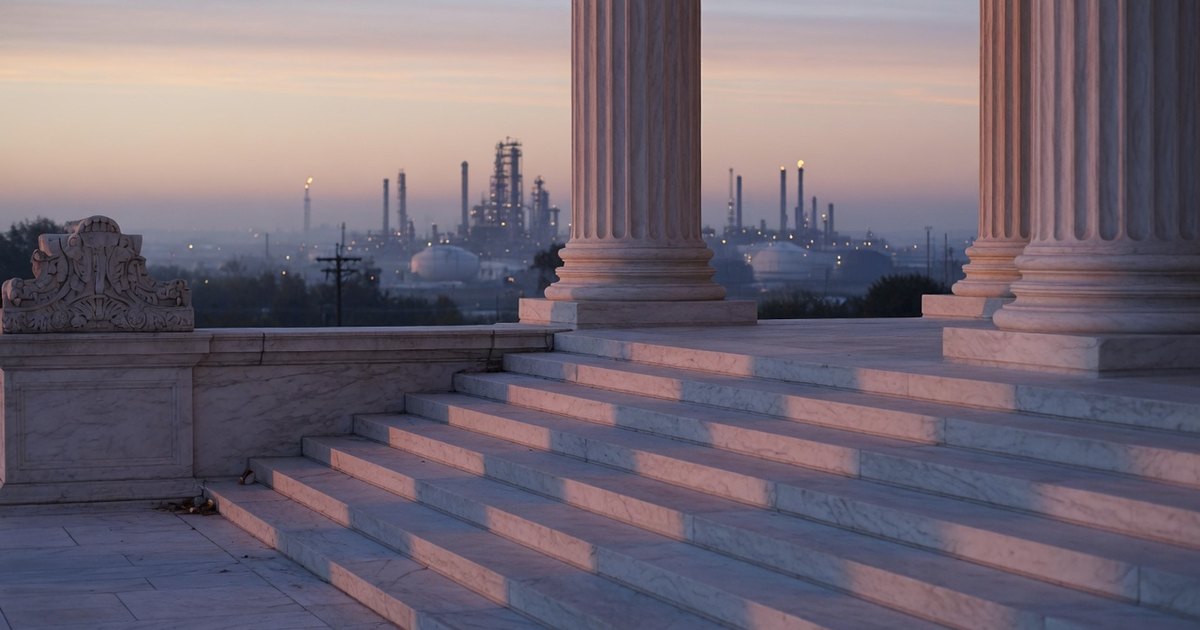
The Supreme Court opened its term with a case that will decide whether a Colorado county can pursue the American oil industry in state court over climate-change costs. On Monday, Oct. 5, the justices heard argument in Suncor Energy (U.S.A.) Inc. v. County Commissioners of Boulder County, No. 25-170, the lead test of whether local governments can use state tort law to collect climate damages from energy producers.
Boulder's city and county governments sued Suncor and ExxonMobil in 2018, and the Associated Press account carried by WCCB Charlotte reported that similar suits have been brought by mostly blue-leaning governments around the country. Billions of dollars are potentially on the line, according to that account, and the companies argue that a loss would effectively let one state's courts regulate emissions everywhere.
There is also an arithmetic problem. Justice Samuel Alito recused himself about a week before argument, following calls for him to step aside over oil-company stock holdings. That leaves eight justices. As the AP noted, a 4-4 deadlock would leave the Colorado Supreme Court's ruling in place, allowing Boulder's case to move forward without setting any national precedent.
Roberts and Kavanaugh Go Looking for the Limit
Kannon K. Shanmugam argued for the energy companies, Principal Deputy Solicitor General Sarah M. Harris appeared for the United States in support of them, and Kevin K. Russell represented Boulder, according to the official transcript of the 122-page session, which began at 10:06 a.m.
Chief Justice John Roberts pressed Russell on where this ends, telling him that "presumably, if you prevail, the next day, a municipality in every single state will file a lawsuit, they'll probably copy your pleadings." Justice Brett Kavanaugh made a similar point about who could be hauled in next.
"I mean, anyone is a potential defendant for a suit like this, any -- any manufacturer, any business."
Justice Elena Kagan pushed the other direction, questioning whether the industry's preemption theory proved too much. "This is chapter 3," she said. "So, if this is chapter 3, were chapters 1 and 2 also preempted?" Shanmugam answered that this was "a very different book." Justice Ketanji Brown Jackson asked about the timing of review, saying, "So why shouldn't we wait and hear all of these claims once the state courts are done." The AP described a possible jurisdictional off-ramp in the case; Jackson's own words went to the problem of taking the dispute up piece by piece.
Two Very Different Descriptions of the Same Lawsuit
The companies and the Trump administration say the suit is a dressed-up attempt to regulate interstate emissions, a job Congress handed the federal government in the Clean Air Act. Harris leaned on a line of precedent including Ouellette, American Electric Power, Pork Producers and Phillips Petroleum. The Justice Department's position, as the AP described it, is that these cases amount to unconstitutional extraterritorial application of Colorado law.
Boulder's lawyers describe something narrower: a claim about alleged public deception, not a demand that anyone cut emissions. The local governments point to real costs, including the 2021 Marshall Fire, which destroyed nearly 1,100 homes, killed two people and caused roughly $2 billion in damage, making it the costliest wildfire in Colorado history.
What the Headlines Claim, and What the Record Shows
Fox News reported under a headline warning that the case could bankrupt oil companies and send gas prices soaring, citing energy experts. That framing comes from the outlet's headline and summary text rather than anything the Court said, and the specific expert claims could not be independently verified here. What is on the record is that bankruptcy came up as a hypothetical during argument, raised from the bench by Kavanaugh.
The legal backdrop is already crowded. The Supreme Court limited EPA's authority over power-plant carbon dioxide in 2022, and the AP reported that EPA moved last month to repeal power-plant emissions rules, drawing suits from states and cities. If federal regulators step back and state courts step in, the practical question of who sets energy policy gets answered in courtrooms rather than Congress.
The AP reported that a decision is expected in the coming months, which would ordinarily mean before the term ends next summer. If eight justices split evenly, Boulder's case simply proceeds in Colorado, no precedent attached, and the parallel suits keep marching forward one docket at a time.
 Guardlane Home Security: Cameras, Sensors and 24/7 App Monitoring
 Social Security Changes Coming in 2026 That Impact Everyone
 Best Gift: Here Are 27+ Of The Coolest Gifts For 2026
 Retirees On SS Are Due A Large Surprise This Week
 Homeowners: See How Much Equity You Could Borrow Without Refinancing
 Lulutox: A 12-Ingredient Tea Blend With Matcha, Goji Berries and Yerba Mate

0 Comments
Be the first to comment.