
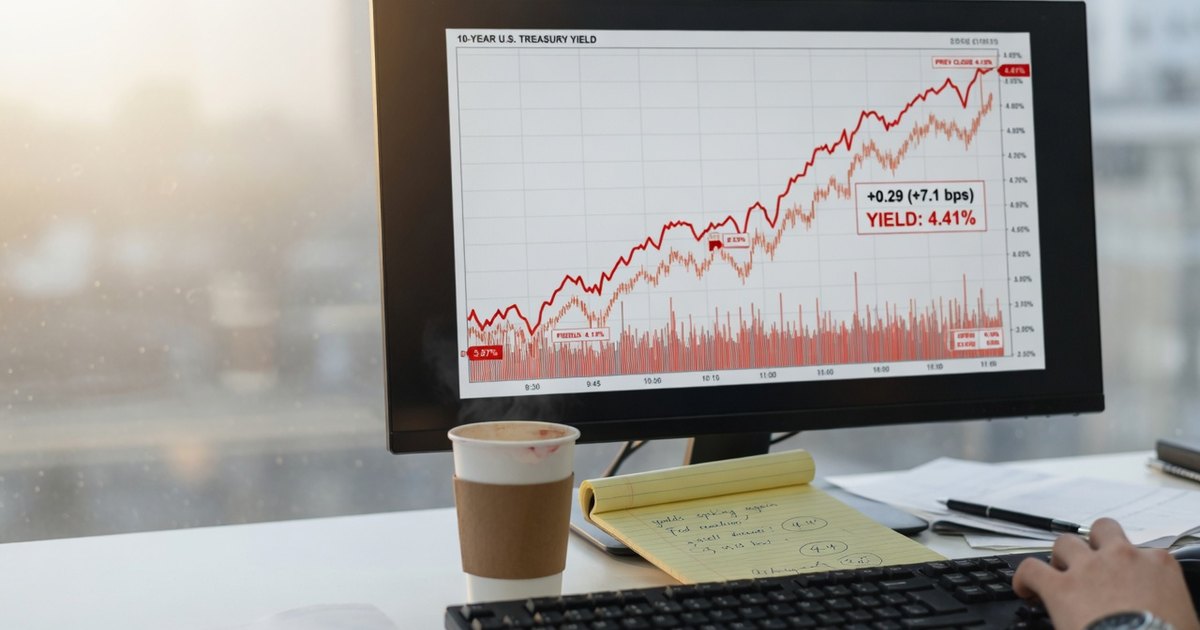
Treasury Secretary Scott Bessent spent the weekend telling anyone who would listen that the bond market is not sending a distress signal about the United States. In an interview with Axios published Saturday, Bessent argued that the climb in Treasury yields matches what is happening in other developed countries and does not, in his words, warrant consternation — even as benchmark rates have reached their highest level in more than two decades.
Bloomberg reported the interview, which ran on Yahoo Finance over the weekend. The timing matters: Treasuries have been in a months-long rout, with the 10-year rate briefly touching its highest point since 2002 earlier in the week, before soft jobs data on Friday brought a measure of relief.
And the Treasury secretary is not pretending he has the wheel. His most candid line was also his most limited: "I can't control the bond market. What I can do is get people to slow down and think."
The Case That This Is Global, Not American
Bessent's argument rests on where the money is going — or rather, where it isn't. If investors had lost faith in American creditworthiness specifically, you would expect them to rotate out of U.S. paper and into somebody else's. He says that is not happening.
"We're not seeing people selling treasuries to buy German bonds or Japanese bonds."
He also drew a distinction between a worldwide repricing of long-dated debt and a run on Washington in particular: "I would be concerned if we were having some kind of idiosyncratic rise," he told Axios. The drivers he and the wire coverage identify are elevated fuel prices from a protracted Iran war, worries about U.S. fiscal health, and surging spending on artificial intelligence.
On the war's economic fallout, Bessent's position is that the ripple effects are masking underlying strength, pointing to consumer spending he called strong and median wage growth running in line with headline inflation. That is the administration's read, and it is worth saying plainly that it is an assertion rather than an audited result. The wire copy carried no rebuttal from economists who see the move in yields as a term-premium problem — investors demanding more compensation to hold long-term U.S. debt because of deficits, not because of oil.
No Bubble in AI, According to the Treasury
Bessent also waved off the growing chorus warning that AI investment has run ahead of reality. His case is that the companies writing the checks are not speculative shells. He named Microsoft, Alphabet's Google and Meta Platforms as firms deploying substantial capital, and pointed to the revenue growth that spending is generating for the likes of Anthropic and OpenAI.
That is a real distinction, and it is also the whole of his argument as the wire reported it. Whether it is a distinction that saves investors from a correction is a separate question, and one no Treasury secretary can answer in an interview.
What the Numbers Do and Don't Show
A note on precision, since this is a story where numbers get thrown around loosely. The 10-year's exact peak and the precise day it hit a 2002 high were not spelled out in the wire account, and the September payroll figure that circulated alongside Friday's jobs report has not been checked against the Bureau of Labor Statistics release. Those belong to the Treasury's daily yield curve and the BLS, not to a weekend interview. What is on the record is the direction: months of selling, a multi-decade high in benchmark rates, and a one-day breather after weak labor data.
Commentary piled up quickly. The Substack newsletter GoldFix led with Bessent's bond-market line and his argument that the energy shock will fade. Other aggregators echoed the global-trend framing. Separately, a trading-news outlet ran a headline naming Tracy Shuchart as commenting on the yield story; the substance of those remarks is not in hand, and this account takes no view on them.
The next few weeks will do more talking than any official. Watch the coming inflation data, the Treasury's quarterly refunding announcement — which tells the market how much long-dated paper is coming at it — and whatever the Federal Reserve says in between. And watch oil, because if the Iran war keeps fuel elevated, Bessent's case that the shock is passing gets harder to make with every delivery.




 Roof More Than 15 Years Old? Get a Free Estimate From a Local Roofer
 Retirees On SS Are Due A Large Surprise This Week
 Mix Salt With Vaseline and Just Watch
 Social Security Changes Coming in 2026 That Impact Everyone
 Lulutox: A 12-Ingredient Tea Blend With Matcha, Goji Berries and Yerba Mate
 Carrying $24,000 or More in Credit Card Debt? See If You Qualify for Relief
0 Comments
Be the first to comment.