
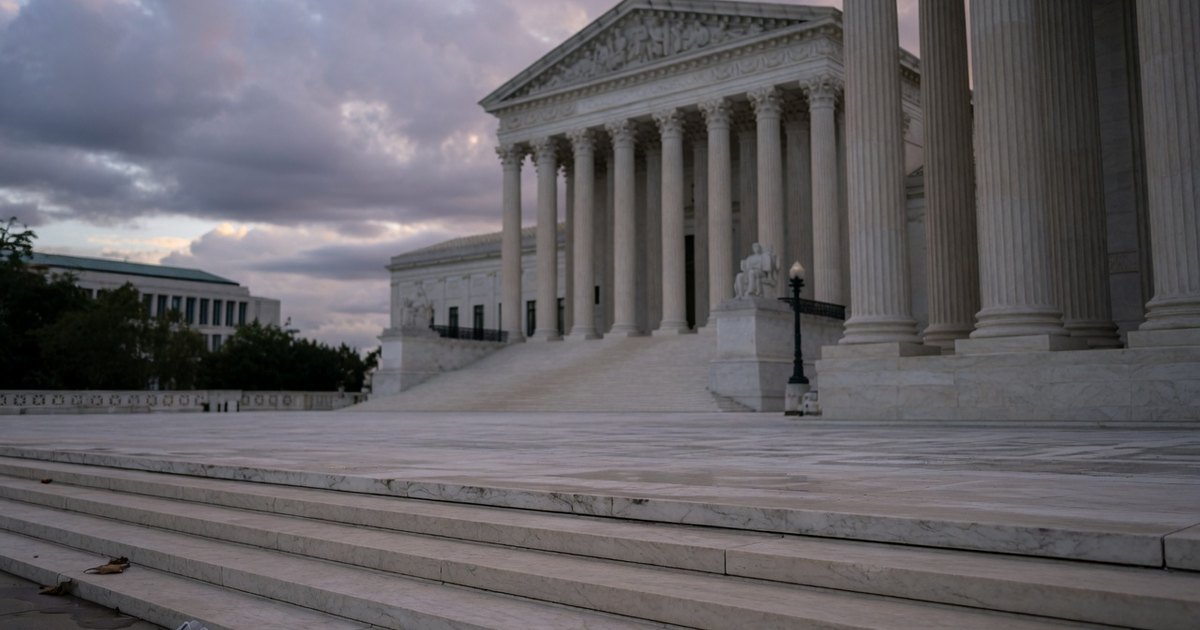
The Supreme Court on Tuesday refused an emergency request from three Democrat-led cities and an immigrant-aid group that wanted a Biden-era immigration rule restored. The 2024 rule let immigration judges pause certain deportation cases. It had been ended by a consent judgment between the Trump Justice Department and the state of Texas.
The order in City of Baltimore v. Texas was unsigned. The Daily Signal reported no noted dissents, and The Federalist called the decision "seemingly unanimous." We have not read the order text ourselves, and we have only partly read The Federalist's article, so the vote count rests on those accounts.
What the Rule Did
The policy came out of the Justice Department's Executive Office for Immigration Review in 2024, according to Just the News. The Daily Signal described it as an "administrative closure" policy. As relayed by SCOTUSblog, it allowed judges to suspend some proceedings, for example when a crime victim or witness was seeking relief such as asylum, while the challengers' appeal in the lower courts is ongoing.
One point worth getting straight. The Just the News headline framed the case as a fight over the powers of lower courts. The Daily Signal noted that immigration judges are Justice Department employees and not part of the federal judiciary.
The Daily Signal, citing SCOTUSblog, reported that Texas sued in June to end the rule. Just the News said only that the Texas agreement came earlier this year, so the timing rests on a single source. Texas's complaint, as relayed by SCOTUSblog and the Signal, called the rule part of the "Biden-Harris Administration's campaign to undermine our immigration laws."
A Consent Judgment, Then a Challenge
The Trump Justice Department did not fight the lawsuit. Accounts differ on how far it went. The Daily Signal said the department did not contest the case, while The Federalist reported that DOJ agreed with Texas and asked a federal judge to invalidate the rule. The outcome was a consent judgment, which Chief U.S. District Judge Reed O'Connor of the Northern District of Texas, a George W. Bush appointee, approved.
That brought in the challengers: Baltimore, Maryland; Columbus, Ohio; New Haven, Connecticut; and Centro Legal de la Raza, an immigration legal group The Federalist described as "leftist-funded." That label is The Federalist's own characterization. The Daily Signal reported that they moved to intervene in August.
Judge O'Connor denied intervention for lack of standing. The cities had argued, in SCOTUSblog's summary as quoted by The Federalist, that "the elimination of the rule would cost them money because their taxpayers are likely to be deported." The judge rejected that argument. The Federalist also reported that the Fifth Circuit rejected the challengers' emergency request, though the text of that passage was cut off in the portion we could read. The Daily Signal reported that the Supreme Court's order leaves in place the lower-court rulings denying interim relief.
What the Court Did Not Say
None of the accounts reviewed for this story report reasons for the Court's decision. Whether it turned on the standing question or on the factors for interim relief is unknown. Readers should treat any confident claim about the Court's reasoning with caution.
Just the News referred to the challengers as immigration groups, while The Federalist and the Daily Signal described the cities as Democrat-led. No public comment from the three cities, Centro Legal de la Raza, Texas officials or the Justice Department turned up in the reporting reviewed here.
What Comes Next
Tuesday's order concerned emergency relief. The challengers' appeal in the lower courts apparently continues, though the sources do not say so explicitly and give no further dates. The order text and SCOTUSblog's report would be the places to confirm that, along with any reaction from the parties.

 Never Put Eggs in a Fridge
 Social Security Changes Coming in 2026 That Impact Everyone
 Home Warranty Plans That Cover AC, Heating and Appliance Repairs
 A Beverly Hills Plastic Surgeon Shares His At-Home Routine for Fine Lines
 Akusoli Insoles: Arch Support and Shock-Absorbing Gel for Tired Feet
 Retirees On SS Are Due A Large Surprise This Week
0 Comments
Be the first to comment.