
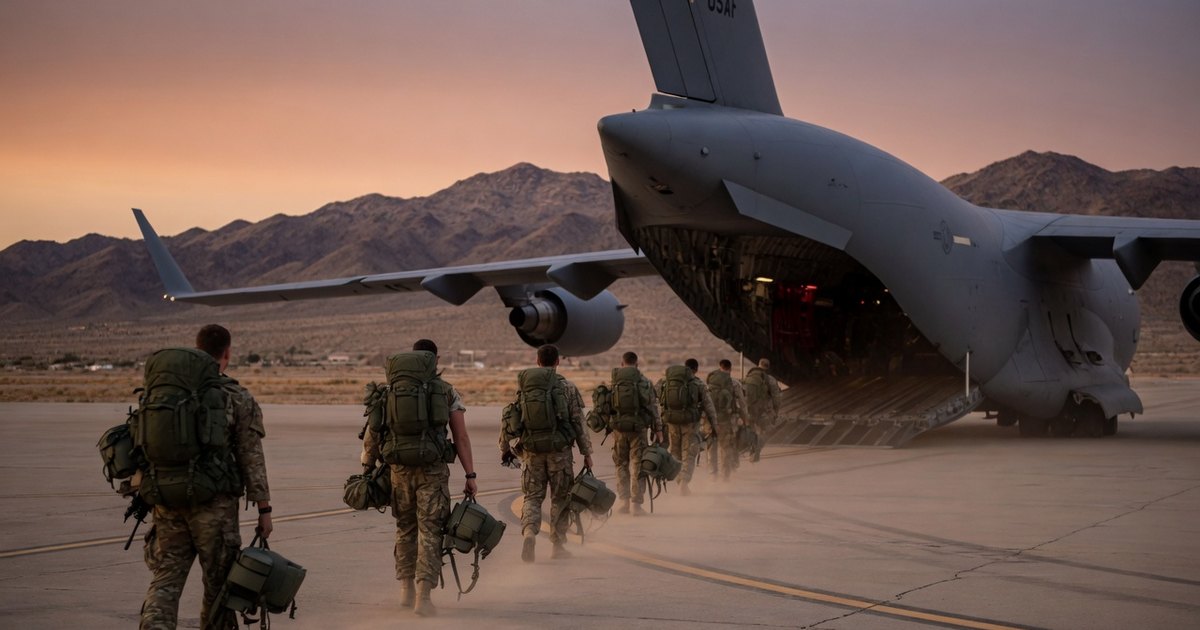
The last American troops left Iraq on Wednesday, flying out of an air base in Irbil and closing a 12-year mission against the Islamic State on the exact date Washington and Baghdad had agreed to two years ago, The Associated Press reported.
President Trump marked the moment in his own terms. "This Day is a victory for the United States, a victory for Iraq, and a decisive victory over ISIS," he said. He was less generous about how the country got there, calling the long American involvement "a very expensive excursion into Hell."
How it ended
The mission that ended this week is not the 2003 invasion. That war formally closed years ago. This one began in 2014, when Iraq's government invited a smaller American-led force back after ISIS overran a third of the country. A 2024 agreement set a wind-down, with Sept. 30, 2026, as the final day. In recent months the American presence had shrunk to hundreds of troops in the semi-autonomous Kurdish north.
Pentagon spokesman Sean Parnell described an "orderly departure" and said the milestone "reflects the success of a 12-year campaign that defeated ISIS as an organized military threat in Iraq." What follows, he said, is "an Iraqi-led security effort" inside a more normal relationship between the two governments. According to the AP, the United States will keep providing targeted training and intelligence support.
Iraqi Prime Minister Ali al-Zaidi called it the start of "a new phase, one defined by Iraq's sovereignty."
The case for leaving
Trump ran three times on ending open-ended deployments, and this is one he can point to as finished. More than 4,400 American service members died in Iraq across two decades. The enemy that brought U.S. forces back in 2014 no longer holds territory there. A deadline was set, announced in advance and kept, which is not how American wars in the region have usually ended.
There was no scramble at an airport and no abandoned embassy. That is worth saying plainly, because the country has recent memory of the alternative.
What the Kurds are saying
The people who hosted the last Americans are not celebrating. The Kurdish regional government's Peshmerga Ministry said the departure, "without the provision of a defense system, is a matter of concern." Kurdish officials told the AP their region absorbed more than 1,000 drone and ballistic-missile attacks during the conflict between the United States and Iran.
The Kurds fought ISIS alongside American troops when the Iraqi army collapsed. They have been the most dependable partner Washington has had in that country, and they now sit within range of Iranian missiles and Iran-backed militias without the American air defenses that were there last month.
Those militias are the other unfinished item. Baghdad had tied the withdrawal date to disarming them, the AP reported. The troops left on schedule. The disarmament deadline has been pushed to June 2027.
What to watch
Leaving was the promise, and it was kept. The harder test is whether the conditions hold without a garrison to enforce them: whether ISIS cells stay scattered, whether Baghdad actually disarms the militias by its new date, and whether the administration finds a way to help the Kurds defend their own airspace. A withdrawal counts as a victory only if nobody has to go back.



 Guardlane Home Security: Cameras, Sensors and 24/7 App Monitoring
 Drivers: These ZIP Codes Pay the Most for Car Insurance (Is Yours on the List?)
 People Born 1939-1969 Are Due A Large Surprise This Week
 Social Security Changes Coming in 2026 That Impact Everyone
 Best Gift: Here Are 27+ Of The Coolest Gifts For 2026
 Derila Ergo: An Ergonomic Pillow Shaped to Support Your Head and Neck
0 Comments
Be the first to comment.