
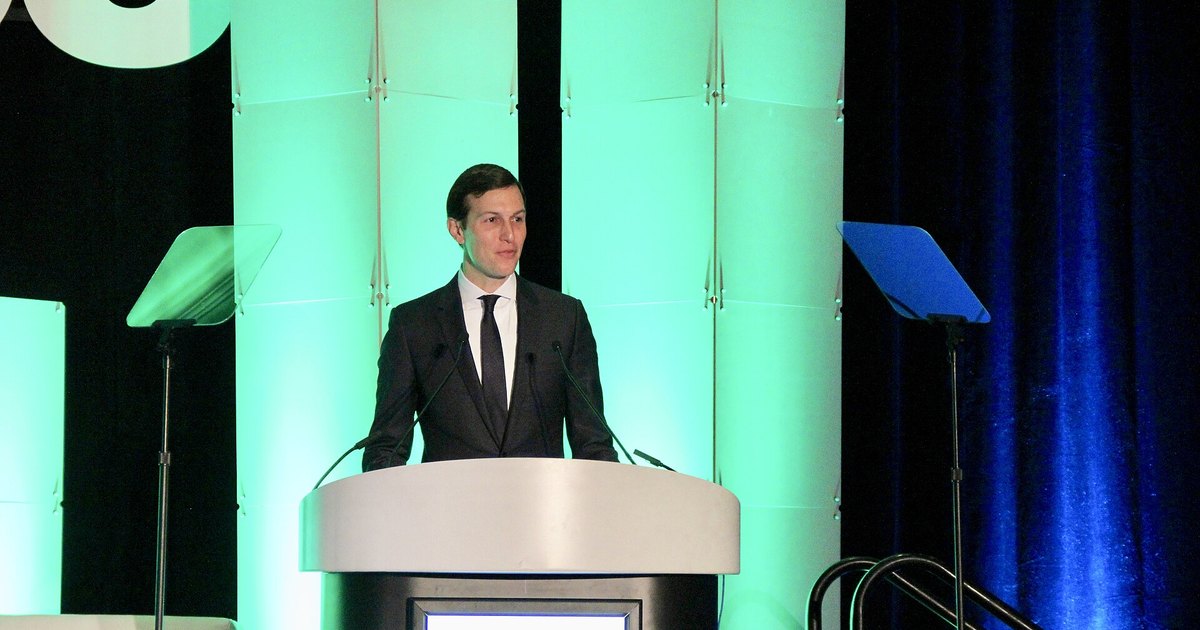
Jared Kushner did not write a letter to the editor. On Thursday he posted a 14-section document on his personal website under the heading "The Facts: My Response to The New Yorker," taking apart, point by point, a September profile that linked fundraising at his investment firm to the unpaid Middle East diplomacy he performs for his father-in-law's administration.
"So, I thought I would try something I have never done before," Kushner wrote. "I am publishing my own fact check." The central claim he disputes is the suggestion that he was quietly rounding up another five billion dollars for Affinity Partners while sitting in talks involving Iran. His answer is blunt: "Affinity has raised zero additional capital during this period. Zero."
The fight matters beyond one magazine and one wealthy son-in-law. Kushner occupies an unusual slot in American public life — a private citizen with no government title and no salary who nonetheless takes part in Middle East negotiations. Every dollar his fund manages gets read by critics as a potential conflict, and he now says the referees have been getting the numbers wrong.
What He Says The New Yorker Got Wrong
The piece in question, "Jared Kushner's Dollar Diplomacy," ran in the magazine's Sept. 21 issue. The Washington Examiner reported that Kushner, 45, was pushing back against accusations of improper business dealings with what he called his own fact check.
In the document, Kushner points to a New York Times report from March 2026 in which Affinity's chief legal officer, Ian Brekke, acknowledged early conversations with investors but said the firm "does not intend to take in any additional capital while Jared is volunteering." Kushner argues that reporting about a completed $5 billion raise has since been repeated as fact by other outlets, including The New Republic and Mediaite, and that both declined to run corrections. "Repetition doesn't make something true," he wrote.
He also objects to the magazine's use of unnamed sources, saying anonymity was used "to allow unnamed sources to make personal attacks and wisecracks without accountability." One named critic quoted in the profile, former White House counsel Virginia Canter, described the arrangement as plagued with conflicts of interest. Kushner says outside ethics counsel and the White House Counsel's Office reviewed his work, that he takes no salary, and that he pays his own expenses.
The Numbers Fight
Much of the document is an argument about arithmetic. Kushner disputes figures describing a 1.25% management fee generating more than $25 million a year, along with a 20% cut of profits. He says Affinity manages roughly $3 billion, that barely a third of it has been deployed about three years into a five-year investment term, and that the fund carries an 8% preferred return to investors before any carried interest is collected. He calls the widely cited $157 million fee total — a number traceable to Sen. Ron Wyden's 2024 inquiry — false, and says it was never put to him during fact-checking.
He does not publish counter-numbers, citing restrictions on what an SEC-registered investment adviser may disclose, and notes that Affinity's assets under management appear in its SEC filings. On a separate CNN story about Affinity's stake in Israel's Phoenix Financial, Kushner writes that CNN itself found no indication his diplomacy affected the investments, that the position was taken before the 2024 election, and that Affinity owns none of the nine defense firms the network cited.
He also flatly denies, in his word "unequivocally," that any secretly recorded call with Saudi Crown Prince Mohammed bin Salman exists, saying there is no transcript. That one is anonymous sourcing against a flat denial and cannot be settled from the public record.
What Is Still Unverified
The New Yorker had not publicly responded as of the sources reviewed, and the profile's author could not be confirmed. Kushner's own document was published on his site and promoted on X the same day; later sections, covering Gaza reconstruction, a development project in Albania, his security clearance, Russia-Ukraine dealmaking and his Harvard record, were available only as headers in the version retrieved, so their contents could not be reviewed here.
Kushner says he intends to update the page over time. Whether Condé Nast issues a correction, and whether Senate Finance or House Oversight treat the exchange as an opening for more letters, is the next thing to watch.
 Akusoli Insoles: Arch Support and Shock-Absorbing Gel for Tired Feet
 Social Security Changes Coming in 2026 That Impact Everyone
 Homeowners: See How Much Equity You Could Borrow Without Refinancing
 21 Senior Discounts and Savings Programs Worth Checking in 2026
 If You Get Social Security, Don't Skip This Month's Benefit Check
 30+ Coolest Gifts Nobody Would Think Of


0 Comments
Be the first to comment.