
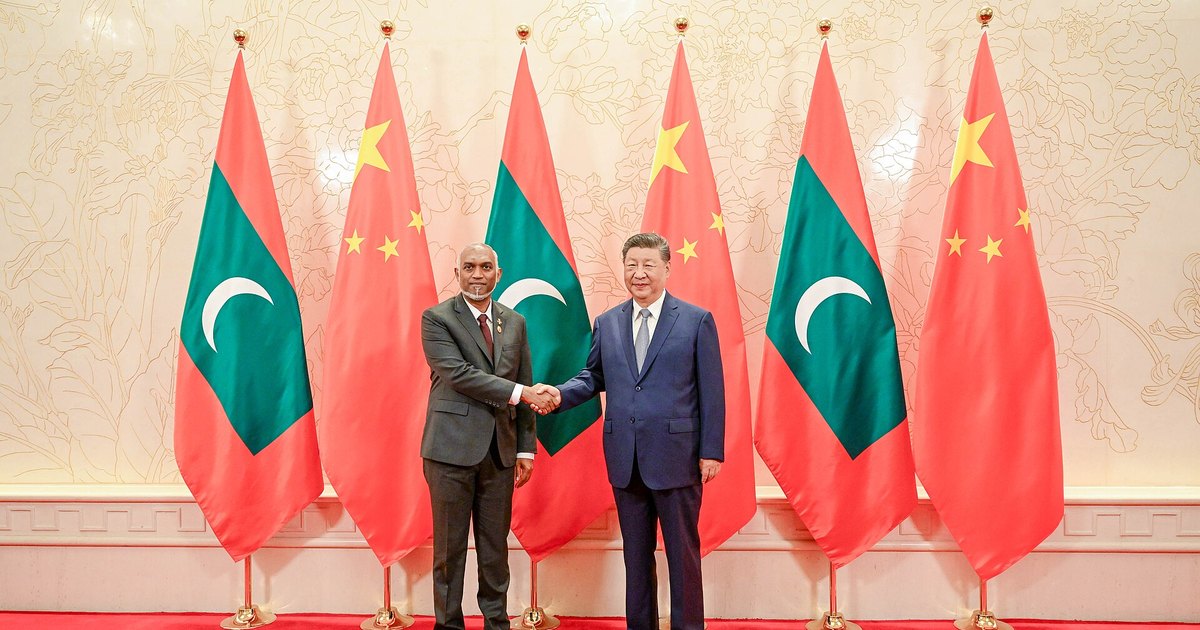
In June, Kazakhstan's minister for artificial intelligence, Zhaslan Madiyev, visited Washington to join the U.S. group working on AI supply chains. Three weeks later he was in Shanghai for a signing ceremony that made Kazakhstan a founding member of the China-inspired World AI Cooperation Organization.
That round trip captures the new shape of the technology contest between the United States and China. Each power is building its own AI bloc, the American-led Pax Silica and the Chinese-inspired organization, and other countries are trying to join both. According to an Associated Press report carried by ClickOnDetroit, experts say the window to choose freely is narrowing.
President Trump said last month that "whoever wins AI, wins," as the AP reported. The notes available for this story do not include where he said it.
Two Clubs, Two Pitches
The choice, as the AP describes it, is between American advanced chips and AI technology on one side and China's cheaper, open-source AI systems on the other.
The Chinese-led organization has 29 initial founding countries, among them Kazakhstan, Pakistan and Russia. The full membership of Pax Silica could not be independently confirmed for this story, nor could the detailed workings of Beijing's group.
The friction between the two powers runs deep. American officials and AI companies accuse China of large-scale distillation, meaning the extraction of capabilities from leading U.S. models. Beijing rejects the claim and says Washington seeks an AI monopoly while restricting China's access to cutting-edge chips and chipmaking machinery. The AP presented both positions without ruling on either, though only part of the AP text was reviewed for this story.
Why Kazakhstan Is Courted by Both
Kazakhstan, a nation of about 21 million, has critical minerals and cheap electricity for data centers. Earlier this year the Kazakh government signed an investment deal worth up to $10 billion involving Nvidia for a "data center valley." The AP text does not say who signed it with whom.
China, meanwhile, is not standing still. Local officials say Chinese foreign direct investment in Kazakhstan hit a record $2.8 billion in 2025, a figure that comes from the Kazakh side and has not been independently verified. In July, Chinese leader Xi Jinping met Kazakh President Kassym-Jomart Tokayev to expand Belt and Road cooperation.
Dana Masalimova, a former Kazakh diplomat and an associate at Harvard's Davis Center for Russian and Eurasian Studies, told the AP that Kazakhstan is in a "very precarious spot." Her summary of the wider landscape was short: "Everyone is hedging."
Even Close Allies Keep a Foot in Both Doors
Kazakhstan is not alone. A version of the AP story published by U.S. News notes that Japan, which lines up closely with Washington on advanced semiconductors, trusted AI and standards, will still use cheaper Chinese models for "lower-risk applications," according to Takahiro Tsuchiya, a professor at Kyoto University of Foreign Studies.
The same report has sections on Indonesia and Singapore possibly being caught between the two powers, on so-called swing countries, and on how hard it is to challenge the two leaders. Those sections were not fully reviewed for this story.
What Comes Next
The visible text of the AP story gives no scheduled next event. The claim that countries will eventually have to choose is the judgment of experts, not official policy in either capital. How long the hedging can last remains an open question.



 Tired of Adding More Pills? Some Seniors Are Trying a Daily Berberine Patch
 Homeowners: Compare Quotes on Energy-Efficient Replacement Windows
 21 Senior Discounts and Savings Programs Worth Checking in 2026
 Dermatologists: The 1 Vitamin You Need If You Have Wrinkles
 If You're Collecting Under $3,950 in SS a Month, You're Eligible for These 10 Benefits
 Never Put Eggs in a Fridge
0 Comments
Be the first to comment.