
As tensions between Washington and Tehran reach a critical juncture, President Donald Trump is making it abundantly clear that the United States will not tolerate a nuclear-armed Iran. With diplomatic talks underway but progress uncertain, the Trump administration is backing its words with unprecedented military readiness, positioning naval assets in the Middle East that signal America’s resolve to prevent Iran from crossing the nuclear threshold.
A President Who Means Business
Speaking to reporters this week, President Trump delivered an unambiguous warning to Iranian leaders: negotiations must succeed, or the United States will take alternative action. “We’re not going to let Iran have a nuclear weapon,” Trump stated firmly, adding that while discussions continue, “if we don’t make a deal, we’ll handle it the other way.”
The president emphasized his preference for diplomatic solutions but made clear that pressure remains a cornerstone of his strategy. “They understand that,” he said of Iranian officials. “We want peace, but it has to be real peace.” It’s the kind of straight talk that has defined Trump’s approach to foreign policy—peace through strength, with no illusions about the nature of the regime in Tehran.
Pentagon Readies Second Carrier Strike Group
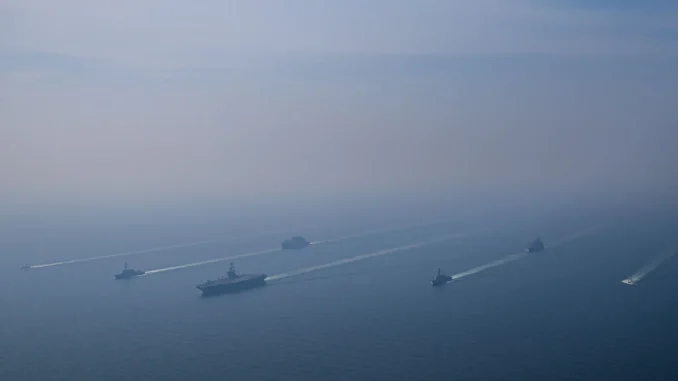
According to reports from The Wall Street Journal, the Pentagon is preparing to deploy a second aircraft carrier strike group to the Middle East, significantly bolstering America’s military presence in the region. The USS George H.W. Bush is reportedly being readied for potential deployment, pending a final order from the president.
This would join the USS Abraham Lincoln strike group, which recently repositioned from the Indo-Pacific to waters near the Arabian Sea. Together, these two carrier groups would represent the most substantial U.S. naval buildup in the region in months, providing Washington with overwhelming military leverage as negotiations progress.
A carrier strike group is far more than just a single ship. At its core is a nuclear-powered aircraft carrier functioning as a mobile air base, capable of launching sustained combat operations with 60 to 75 aircraft. These include F/A-18 Super Hornet fighter jets, EA-18G Growler electronic warfare aircraft, E-2D Hawkeye airborne early warning planes, and MH-60 Seahawk helicopters. The strike group also deploys guided-missile cruisers and destroyers equipped with the Aegis combat system for air and ballistic missile defense, often supported by attack submarines providing undersea warfare capability.
In short, two carrier strike groups deliver long-range strike power, missile defense, maritime security, and rapid-response capability—exactly what’s needed to deter Iranian aggression and protect American interests in the region.
Diplomatic Talks Resume in Oman
Indirect negotiations between the United States and Iran resumed on February 6 in Muscat, Oman, marking the first sustained diplomatic engagement since tensions flared last year involving Iranian-backed militias and U.S. forces. American officials have made clear that any agreement must permanently prevent Iran from obtaining a nuclear weapon and must include rigorous inspection and verification mechanisms.
Secretary of State Marco Rubio emphasized the administration’s red line: “Iran can never have a nuclear weapon.” He stressed that enforcement and transparency are non-negotiable components of any potential deal. The Trump administration is also pressing for broader discussions that address Iran’s ballistic missile program and its support for proxy groups destabilizing the Middle East.
Iranian leaders, however, have resisted expanding the talks beyond nuclear issues. They insist their nuclear program is peaceful and reject what they characterize as unrelated demands. Meanwhile, Iran continues enriching uranium to high levels—approaching weapons-grade thresholds that Western officials warn could dramatically shorten Tehran’s nuclear breakout timeline.
Iranian President Masoud Pezeshkian claimed this week that Iran does not seek nuclear weapons and is prepared to provide assurances about its nuclear activities. However, he offered no indication that enrichment would cease—a critical sticking point in any negotiation.
Coordination with Israel
On Wednesday, President Trump met with Israeli Prime Minister Benjamin Netanyahu at the White House, where Iran dominated the agenda. Following the meeting, Trump reiterated his insistence that negotiations continue to explore whether a deal can be reached, but he repeated his bottom line: “We will not allow Iran to have a nuclear weapon.”
Netanyahu stressed that Israel’s position goes beyond just uranium enrichment. Any acceptable agreement must also address Iran’s ballistic missile capabilities and its support for armed groups throughout the region. Israeli officials have consistently warned that a narrow nuclear agreement would leave broader security threats intact—a concern the Trump administration appears to share.
Strength as the Path to Peace
President Trump’s approach to Iran is consistent with his broader foreign policy philosophy: speak clearly, back your words with strength, and never allow adversaries to mistake restraint for weakness. By positioning two carrier strike groups in the Middle East while pursuing diplomatic channels, the administration is sending an unmistakable signal to Tehran.
The Pentagon has not announced a final deployment decision, but defense officials note that preparing a strike group ensures the United States can move swiftly if circumstances require it. As negotiations continue in Oman, the world watches to see whether Iran will choose the path of genuine peace or force America’s hand.
One thing is certain: under President Trump, the United States will not sit idly by while Iran pursues nuclear weapons. The message to Tehran is clear—diplomacy is the preferred path, but America stands ready to act decisively to protect its interests and those of its allies.